
Boxabl New Detached ADU: The San Bernardino Owner’s Guide
Boxabl-compatible new detached ADU installation in San Bernardino typically runs $180,000 to $280,000 all-in, including the permit set, site prep, utility tie-ins, and final inspection. We specify and coordinate Boxabl systems under our single-contract design-build model, and we keep current on the Casita line’s connection specs, foundation anchoring details, and San Bernardino County’s specific modular installation checklist. Most owners find us after their Boxabl unit arrives and they realize the gap between “delivered” and “move-in ready” involves more trades than the purchase agreement covered.
Which Boxabl Models This Applies To
This page covers the Boxabl Casita, the 20-by-20-foot, 375-square-foot unit that ships foldable and expands on-site. We also work with the larger configurations Boxabl has teased for future release, though as of 2024 the Casita remains the only production model available for residential delivery in California.
To identify your exact unit, check the metal data plate riveted to the electrical panel enclosure. It lists the manufacturing date, serial prefix, and the specific revision of the structural connection kit. Revisions matter: early Casitas used a bolt pattern that differed slightly from units manufactured after Q2 2023, when Boxabl standardized the corner-column interface. If your data plate shows a serial beginning with “BCA-22,” call us before ordering any foundation hardware. We have both patterns in our San Bernardino warehouse, but sending the wrong one costs a week.
On OEM versus aftermarket: Boxabl sells their own connection and finish kits direct, but lead times run 8 to 12 weeks. We stock compatible structural hardware from Simpson Strong-Tie and specify equivalent-rated fasteners that meet San Bernardino County’s wind-load requirements without the Boxabl markup. For finishes, we match Boxabl’s interior panel specs using locally sourced materials where possible, which matters when you need a replacement panel in two days, not two months.
Signs Your Boxabl New Detached ADU Is Failing
- Corner-column separation at the fold seam. The Casita expands from folded to flat using a hinge mechanism at the roof-wall joint. In San Bernardino’s high-desert temperature swings, the butyl tape seal can fatigue and allow moisture intrusion. You will see staining on the interior ceiling panel near the hinge line, or feel a draft during Santa Ana wind events.
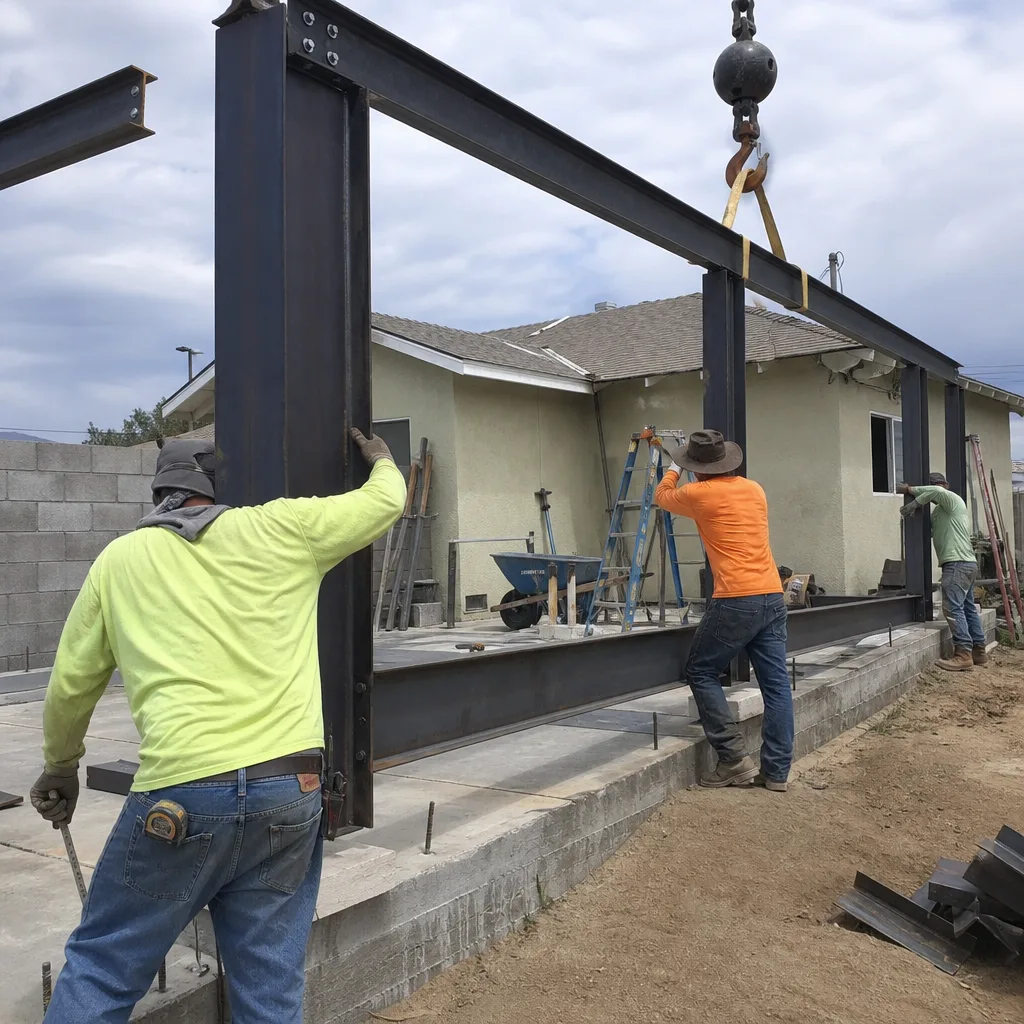
- Foundation anchor bolt loosening or elongation. The Casita’s lightweight steel frame transfers wind loads through four corner anchors into your concrete pier or slab. If the torque on these bolts was not verified at 90 days, thermal cycling can back them off. The symptom is a slight rocking sensation when you walk across the unit, or visible gap between the base track and the concrete.
- HVAC mini-split refrigerant line kinking at the exterior penetration. Boxabl routes the lines through a pre-punched sleeve in the wall panel. If the unit was set without proper slack in the lines, settlement or wind load can pinch the copper. You will get reduced cooling capacity first, then ice formation on the evaporator, then compressor short-cycling.
- Electrical sub-panel ground fault trips under load. The Casita ships with a 100-amp sub-panel fed from your main house. If the grounding electrode conductor was not bonded to the San Bernardino County-required ground rod at installation, voltage fluctuation from the utility or from your main panel can trip the GFCI breakers. This reads as “random” power loss to appliances.
- Exterior finish panel delamination at south-facing walls. The composite siding on early Casitas uses a laminate that degrades faster under sustained UV above 2,500 feet elevation. San Bernardino sits at roughly 1,000 feet, but many surrounding foothill installations see this failure mode. You will notice bubbling at the panel edges, then chalking, then substrate exposure.
Replacement Cost & What’s Included
For a Boxabl Casita in San Bernardino, our typical installed scope runs $180,000 to $280,000 depending on whether you need full site prep, utility extension from the main house, or just the unit set and finish-out on an existing pad. That range includes the permit set, San Bernardino County plan check, foundation design for your specific soils report, utility trenching and meter coordination, and final inspection sign-off.
What drives the spread: distance from your main electrical panel to the Casita location, slope of the lot (cut-and-fill requirements), and whether San Bernardino County requires a geotechnical report for your specific parcel. Under Haven Standard Clause 1, we deliver a written line-item price before any work starts. No range so wide it’s useless. Tell me the lot dimensions and I can give you a real number.
Our workmanship on Boxabl installations carries the 365-Day Done Right Promise. If the finished ADU does not match the permitted drawings, we make it right, in writing, before the project starts.
DIY or Call Us?
There is exactly one task we encourage owners to handle themselves: verify the serial number and revision on your data plate before you call. Everything else benefits from a licensed design-build practice.
The foundation anchoring and electrical tie-in are not DIY projects. San Bernardino County requires a structural engineer’s wet stamp on the foundation plan, and the electrical sub-panel must pass inspection under NEC 2020 with local amendments. Attempting your own anchor bolt torque without a calibrated wrench can strip the threaded inserts in the Casita’s corner columns. That turns a $400 hardware replacement into a $6,000 corner-column repair.
What you can safely check: walk the perimeter and look for gap or rust at the base track. Listen for creaking in wind. Note any interior panel staining. Then call (909) 359-6463 with what you found. We will tell you whether it needs a truck roll or just a photo review.
FAQs
From permit submission to final inspection, most San Bernardino County Boxabl projects run 14 to 18 weeks. The Casita itself sets in one day once the foundation cures, but plan check, utility coordination, and inspection scheduling drive the timeline. Call (909) 359-6463 and we can review your specific parcel’s requirements.
Some can. Corner-column tape seals and exterior panel delamination are repairable if caught before substrate damage. Structural anchor elongation or electrical ground-fault issues require full replacement of the affected component to pass inspection. We document what we find with photos and give you both options where repair is viable.
We stock structural fasteners, foundation hardware for both pre- and post-Q2-2023 bolt patterns, and compatible finish materials. OEM Boxabl panels and connection kits we order direct with expedited shipping. For most San Bernardino installations, we can have compatible hardware on-site within 48 hours.
With proper installation and maintenance, 30 to 40 years. The high-desert UV and temperature cycling are harder on exterior finishes than on the steel frame. We specify upgraded laminate panels and verify anchor torque at 90 days to address the two failure modes we see most often in San Bernardino County installations.
Written by Nadia Ellery, Owner, Ellery ADU Studio San Bernardino at Ellery ADU Studio San Bernardino, serving San Bernardino and nearby areas.