
Last updated September 25, 2026
How to Hire a ADU Contractor in San Bernardino: A Step-by-Step Guide
California’s Contractors State License Board lists over 300 active general contractors in San Bernardino County; fewer than 12 percent carry the design liability that an ADU project’s permit set legally requires. Most homeowners start by asking “how do I find a good contractor,” but the question that actually protects your investment is different: how do you structure the contract so the designer and builder are the same legal party? In San Bernardino’s ADU market, where garage conversions in neighborhoods like Arrowhead and Del Rosa face distinct setback and utility challenges, the blame gap between designer and builder is where projects stall, over-budget, or fail inspection. This guide walks through license verification, insurance reading, bid comparison, and contract language that closes that gap, and you can explore more guides & resources on our blog.
Quick Answer
To hire an ADU contractor in San Bernardino, verify the CSLB license classification covers both design and construction (or confirm a single entity holds both), request a certificate of insurance naming you as additional insured with minimum $1 million per occurrence, and insist on a written fixed price before work starts with permit-set ownership defined in the contract. The lowest bid is rarely the cheapest project; compare all-in costs including drawings, permits, and utility connections.
Table of Contents
- CSLB License Classifications: What Each One Actually Covers
- How to Read a Contractor’s Insurance Certificate
- Three Contract Clauses That Protect Your Permit Set
- How to Compare Bids: The Dollar-to-Dollar Translation
- Red Flags in San Bernardino ADU Bids
- The Hiring Process: A 7-Step Checklist
- Common Mistakes to Avoid
- When to Call a Professional
- Frequently Asked Questions
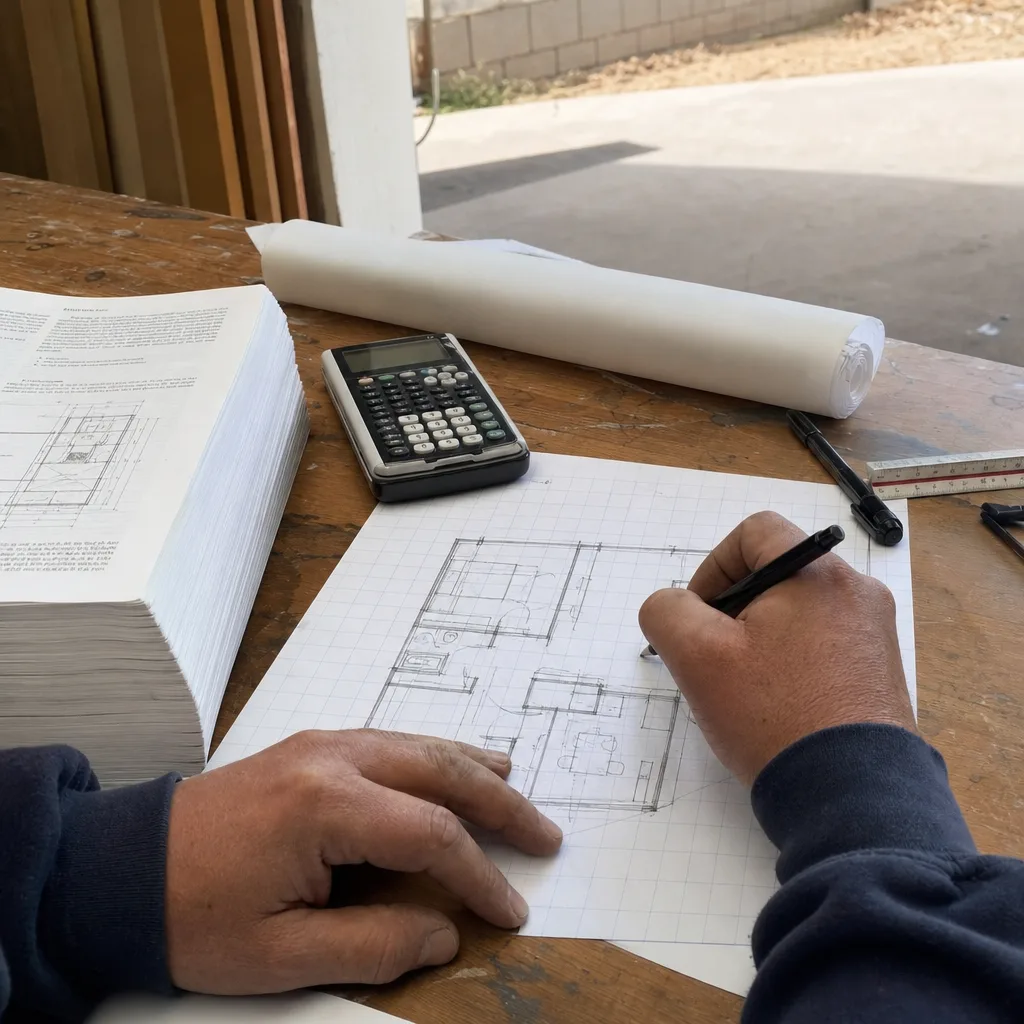
CSLB License Classifications: What Each One Actually Covers
San Bernardino homeowners often assume a B-General Building Contractor license means the holder can handle their entire ADU project. It does not. The CSLB issues specific classifications, and understanding the boundaries of each prevents the mid-project discovery that your “contractor” cannot legally produce the drawings your permit requires.
Here is what each relevant classification authorizes:
- B-General Building Contractor: Can construct structures, but cannot design or draft the architectural plans required for permit submission. A B licensee may hire or subcontract design work, but the homeowner then has two separate contractual relationships. When those conflict, the B contractor typically points to the designer; the designer points to field conditions the contractor created.
- C-36 Plumbing Contractor: Authorized for water, sewer, and gas lines only. Cannot perform structural, electrical, or design work. In San Bernardino’s older neighborhoods like Muscoy and Verdemont, original galvanized water lines and clay sewer laterals mean ADU utility tie-ins frequently require C-36 expertise, but this is one trade among several.
- C-10 Electrical Contractor: Authorized for electrical systems only. San Bernardino’s 100-amp service panels common in pre-1980 homes often require upgrades to 200-amp for ADU loads; a C-10 must perform this work, but cannot touch structure or plumbing.
- A-General Engineering Contractor: Required for significant grading, retaining walls over 4 feet, and hillside stabilization. The foothill zones near North Park and University Hills sometimes trigger this requirement when site prep involves cut-and-fill beyond basic pad preparation.
- Architect (licensed by California Architects Board, not CSLB): Legally authorized to produce stamped architectural drawings. An architect may hire a B-General to build, but again: two contracts, two parties, one blame gap.
The design-build model exists precisely to collapse these multiple licenses into a single contract. At Ellery ADU Studio San Bernardino, the permit set, the construction, and the final inspection walkthrough are one agreement at one written price. If the field condition requires a drawing revision, there is no dispute about who pays - the same entity holds both liabilities.
When evaluating a San Bernardino ADU contractor, ask directly: “What license classification will appear on the permit application, and who owns the drawings if this relationship ends?” If the answer involves multiple company names or a shrug, you have identified the blame gap before signing.
How to Read a Contractor’s Insurance Certificate
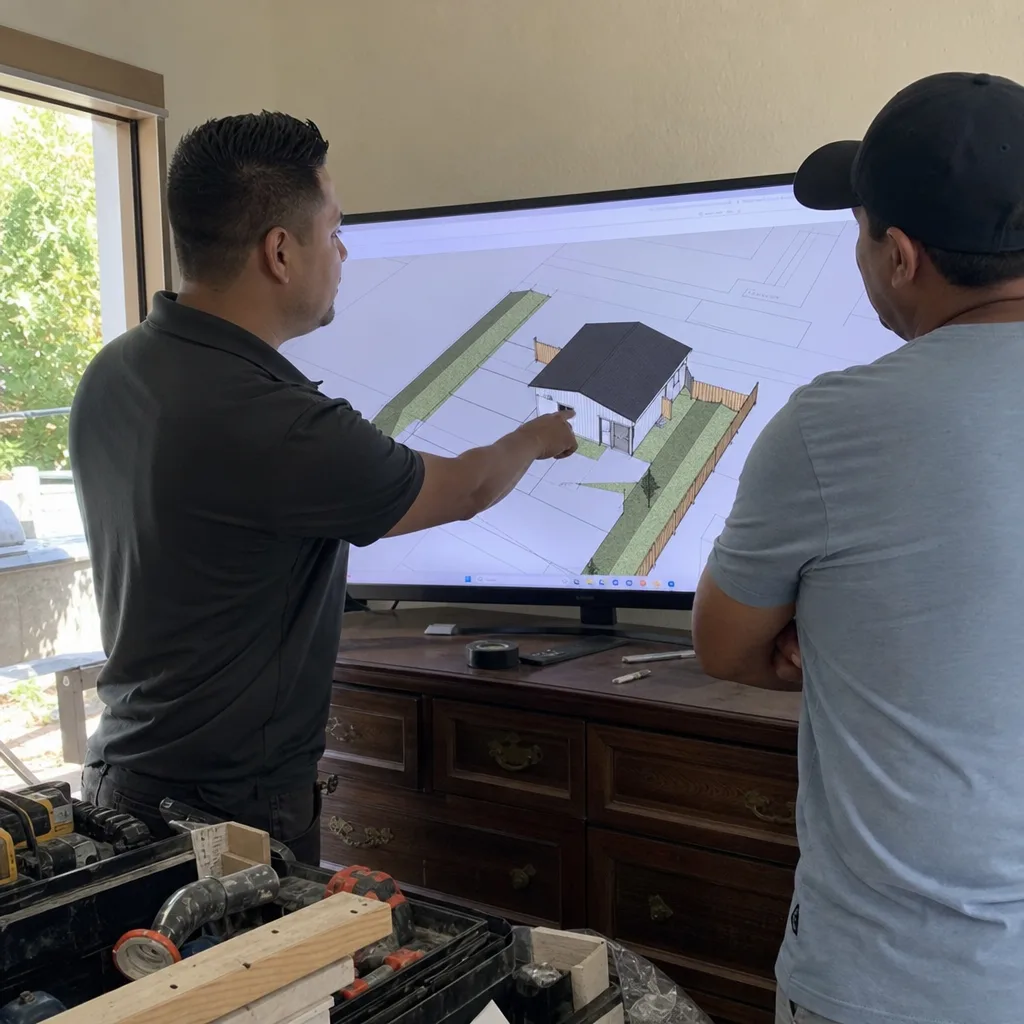
Requesting proof of insurance is standard. Reading it correctly is not. San Bernardino homeowners should demand a certificate of insurance (COI) with specific language that actually protects them, not merely confirms a policy exists.
Three coverage types matter for ADU construction:
- General Liability: Covers property damage and bodily injury during construction. Minimum $1 million per occurrence, $2 million aggregate. In San Bernardino’s fire-prone climate, verify this includes completed operations coverage - protection if a defect causes damage after the crew leaves.
- Workers’ Compensation: Mandatory in California if the contractor employs anyone. The certificate should list the CSLB license number and match the name on your contract. Uninsured worker injuries on your property can become your homeowner’s policy claim, or worse, your personal liability.
- Professional Liability (Errors & Omissions): Covers design defects. This is the coverage most B-General contractors lack, because they do not perform design. If your ADU’s roof drains toward the foundation because the site plan had an elevation error, general liability often excludes this; professional liability covers it. Design-build studios carrying both construction and design risk maintain this coverage as a matter of course.
Named-insured language matters. The COI should name you, the homeowner, as “additional insured” with a specific endorsement, not merely “certificate holder.” Certificate holder status means you get notified if the policy cancels; additional insured status means the policy covers claims you file. Ask for this in writing.
Also verify the policy dates span your project timeline. San Bernardino’s Planning Division and Building & Safety Division typically take 8-14 weeks for ADU plan review; construction adds 4-8 months depending on scope. A policy expiring mid-project leaves you exposed.
At Ellery ADU Studio, every client receives the current COI with additional insured endorsement before the contract is signed, not after. The license number on that certificate matches the permit application exactly.
Three Contract Clauses That Protect Your Permit Set
Most standard residential construction contracts - the templates available online, the forms many San Bernardino contractors adapt - contain a fatal blank space: they do not specify who owns the permit drawings if the relationship terminates. This matters because you cannot pull a new permit with someone else’s drawings, and you cannot complete construction without a permit.
Three clauses should appear in every ADU contract:
- Permit Set Ownership and Transfer: The contract must state that upon final payment, the architectural drawings, structural calculations, and energy compliance documentation (Title 24) become your property. Better yet, the contract should specify that these are your property upon permit issuance, not project completion - because if the builder walks away mid-framing, you still need those drawings to hire a replacement. Most standard contracts assign copyright to the designer and license it to the builder; if the designer and builder are separate entities, you may own nothing usable.
- Drawing Revision Responsibility: When the city requests corrections during plan check - common in San Bernardino for fire separation details between garage conversions and primary residences - who pays for the revised sheets? The contract must assign this cost, not leave it to negotiation after you’ve already paid a deposit. Under ADU Design & Permitting in San Bernardino, revision cycles are included in the fixed price because the same entity bears both design and construction risk.
- Digital File Format and Access: Insist on AutoCAD .dwg or Revit source files, not just PDFs. PDFs cannot be revised for a new permit application. The contract should specify file format, delivery method, and timeline. We have seen San Bernardino homeowners hold a $40,000 set of beautiful renderings in PDF format, useless for completing their project with a different builder.
The Haven Standard addresses this in Clause 3 (Document Ownership): the permit set, photo record, and as-built drawings transfer to the client upon final inspection. There is no ambiguity because there is no second party to dispute it.
How to Compare Bids: The Dollar-to-Dollar Translation
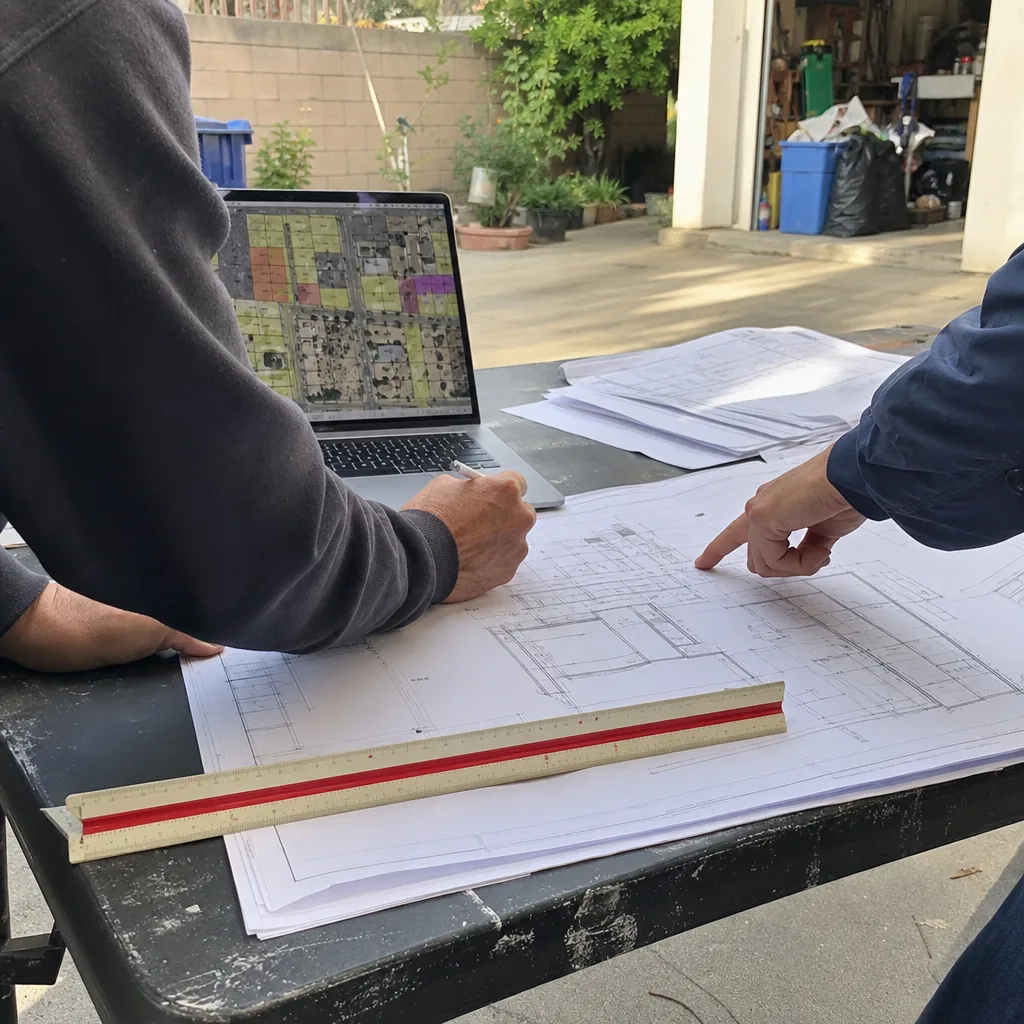
San Bernardino homeowners routinely receive bids that appear $30,000-$80,000 apart for the same ADU. The gap is usually illusory: one bid includes design and permitting; the other assumes you will hire an architect separately. For a detailed breakdown, see our ADU Cost Breakdown: The San Bernardino Homeowner’s Reference for 2026.
Start by building a line-item comparison table. Every bid should be forced into these categories:
- Architectural Design & Permit Set: Stamped drawings, Title 24 energy calculations, structural calculations if required. In San Bernardino, this typically ranges $8,000-$18,000 for garage conversions, $12,000-$28,000 for new detached units depending on complexity. If a bid excludes this, add the market rate to their total.
- Permit Fees: San Bernardino Building & Safety charges plan check and inspection fees based on valuation. For a 500-square-foot garage conversion, expect $2,500-$4,500; for a 750-square-foot detached ADU, $4,000-$7,000. Some bids bury this in “allowances” or exclude it entirely.
- Site Prep & Utilities: Grading, trenching, sewer lateral extension, electrical service upgrade, gas line extension. In San Bernardino’s older neighborhoods with original clay sewer lines, lateral replacement can add $4,000-$12,000. Mountain Avenue corridor properties with septic systems rather than sewer may need perc testing and leach field expansion - a five-figure line item many bids omit.
- Construction (Fixed Line Items): Foundation, framing, roofing, MEP (mechanical, electrical, plumbing), insulation, drywall, flooring, fixtures. Each should carry a fixed price, not an allowance. Allowances are not prices; they are guesses that become change orders.
- Contingency: 5-10 percent for unforeseen conditions, held by the contract terms, not spent by default. The Haven Standard caps this at 5 percent and requires written homeowner approval for any draw.
Once normalized, the “cheaper” bid often costs more. We recently reviewed a San Bernardino homeowner’s competing bids: Contractor A at $145,000 with no design included; Contractor B at $168,000 all-in. After adding $16,000 for architectural drawings and $3,200 for permit fees to Contractor A, the true comparison was $164,200 versus $168,000 - with Contractor B holding single-point liability and Contractor B’s bid including a 365-Day Done Right Promise that Contractor A’s standard contract lacked entirely.
The translation method: add missing line items at market rate, convert allowances to fixed prices using your own specifications, then compare total project cost with risk allocation included.
Red Flags in San Bernardino ADU Bids
San Bernardino’s ADU market has matured since the 2017 and 2020 state law changes, but certain practices persist that signal trouble. Watch for these specific patterns:
- Permits pulled under a subcontractor’s license: The contract is with Company A, but the building permit lists Company B’s license number. This means Company A is not legally responsible for the work. If Company B disappears or disputes arise, your recourse against Company A is limited. The license on the permit must match the contract.
- Scope exclusions buried in Exhibit B: The main contract pages show an attractive price; the exclusions live in attached exhibits with smaller font or cross-references. Common exclusions in San Bernardino: fire sprinkler requirements for ADUs over certain square footage, seismic retrofit of existing garage foundations, and ADA-compliant path of travel. Each exclusion can add $5,000-$20,000.
- Allowances used in place of fixed line items: “Tile allowance: $800” sounds specific until you select tile that costs $2,400 installed. The $1,600 difference becomes a change order. Fixed line items require the contractor to price actual selections before signing, which is precisely why some avoid them.
- No mention of San Bernardino’s specific requirements: The city’s ADU ordinance includes parking replacement rules, front setback modifications for conversions, and specific fire separation ratings for garage conversions. A bid that reads like it could be for any California city probably was not written for San Bernardino.
- Prefabricated or modular systems without brand specification: “Prefab ADU: $95,000” is not a bid; it is a category. Systems from Mighty Buildings, Boxabl, and Plant Prefab have different structural systems, utility connection points, and San Bernardino approval statuses. Ellery ADU Studio specifies and coordinates these brands within the same single contract, with the structural and MEP integration priced as fixed line items, not allowances.
One additional San Bernardino-specific caution: the city’s historic overlay districts, including portions of the Arrowhead and Downtown areas, trigger additional design review and seasonal considerations covered in our Seasonal ADU Care for San Bernardino: Year-Round Homeowner’s Guide. A bid that does not mention HPOZ (Historic Property Overlay Zone) compliance either assumes you will handle it separately or does not know it applies.
The Hiring Process: A 7-Step Checklist
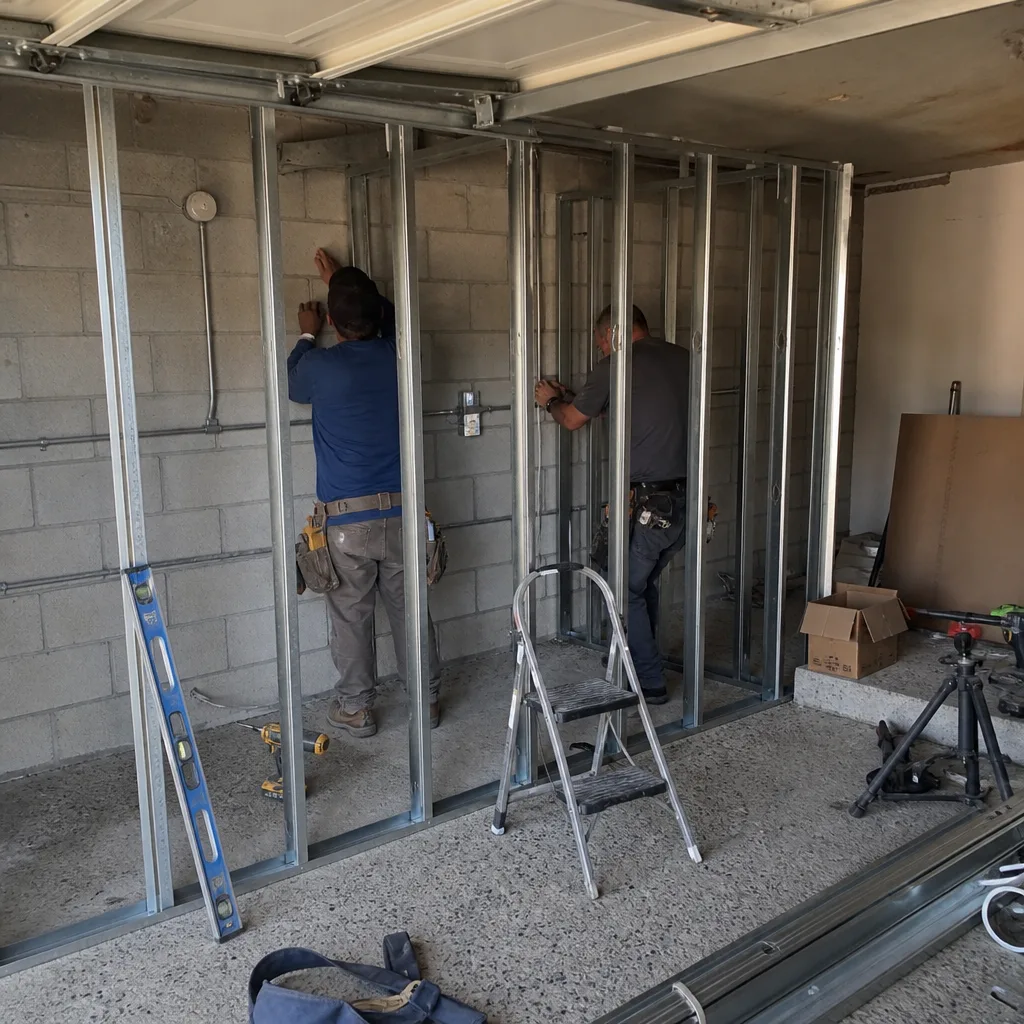
Use this sequence to structure your search and protect your position at each stage.
- Verify the CSLB license. Visit cslb.ca.gov and enter the license number from the contractor’s card or proposal. Confirm status is “Active,” the classification matches the work (B-General minimum, with design capability confirmed separately if not design-build), and there are no pending disciplinary actions. Note the license issue date; San Bernardino’s ADU boom attracted many newly licensed contractors with limited project experience.
- Request three recent ADU project references in San Bernardino County. Not “remodeling” or “additions” - ADU-specific work with permit numbers you can verify. Call the homeowners and ask: Did the final price match the written quote? Were permits pulled before work started? Would they hire this contractor again?
- Demand a written, line-item fixed price before any work begins. This is non-negotiable. The Haven Standard, Clause 1, requires it; any contractor unwilling to commit to a fixed price is transferring risk to you. At Garage Conversion ADU in San Bernardino, every project starts with a written scope and price, not an estimate that “might change.”
- Review the insurance certificate with the three-coverages checklist above. Additional insured endorsement. Matching license number. Dates spanning your project. No exceptions.
- Read the contract for permit-set ownership, revision responsibility, and digital file access. If these are absent or vague, the contract was written for the contractor’s protection, not yours.
- Compare normalized bids using the dollar-to-dollar translation method. Add missing line items at market rate. Convert allowances to fixed prices. Include risk allocation (single-contract versus multi-party) as a cost factor, because the blame gap has a price even if it does not appear on the page.
- Schedule a pre-construction meeting with the specific project manager and lead carpenter who will execute the work. The salesperson who sold the project often departs before breaking ground. Meet the people who will be on your property. In San Bernardino’s climate, where summer temperatures exceed 100°F and winter rain patterns affect concrete curing schedules, field leadership matters more than sales polish.
Ellery ADU Studio offers a Free Second Opinion on any written estimate already in hand. We will apply this checklist and show you what the bid actually contains, not what it implies.
Common Mistakes to Avoid
- Hiring based on the lowest initial number without normalizing for scope. The $120,000 bid that excludes design, permits, and utility connections is not cheaper than the $155,000 all-in price. It is merely less complete.
- Accepting “we’ll pull permits later” for any reason. Unpermitted ADU work in San Bernardino triggers code enforcement, potential demolition orders, and eliminates the rental income that justified the project. Permits are not a detail; they are the legal foundation.
- Signing a contract with a “design phase” deposit before confirming who owns the resulting drawings. We have seen homeowners pay $8,000 for a permit set they cannot use with any other builder because the contract assigned copyright to the designer.
- Ignoring San Bernardino’s specific utility constraints. Properties served by San Bernardino Municipal Water Department versus Bear Valley Electric versus Southern California Edison have different service upgrade requirements, timelines, and costs. A bid that does not name your utility provider has not been prepared for your project.
- Selecting prefab or modular without confirming San Bernardino approval. Not all factory-built systems are approved for San Bernardino installation. Tuff Shed-style structures, for example, require specific structural engineering for seismic and wind loads that standard models may not include.
- Failing to document existing conditions before construction starts. Cracks in the existing garage slab, drainage patterns, tree root intrusions - these become disputes when discovered mid-project. Demand a documented photo record of existing conditions, included in the contract. The Haven Standard requires this on every visit, not just at project start.
When to Call a Professional
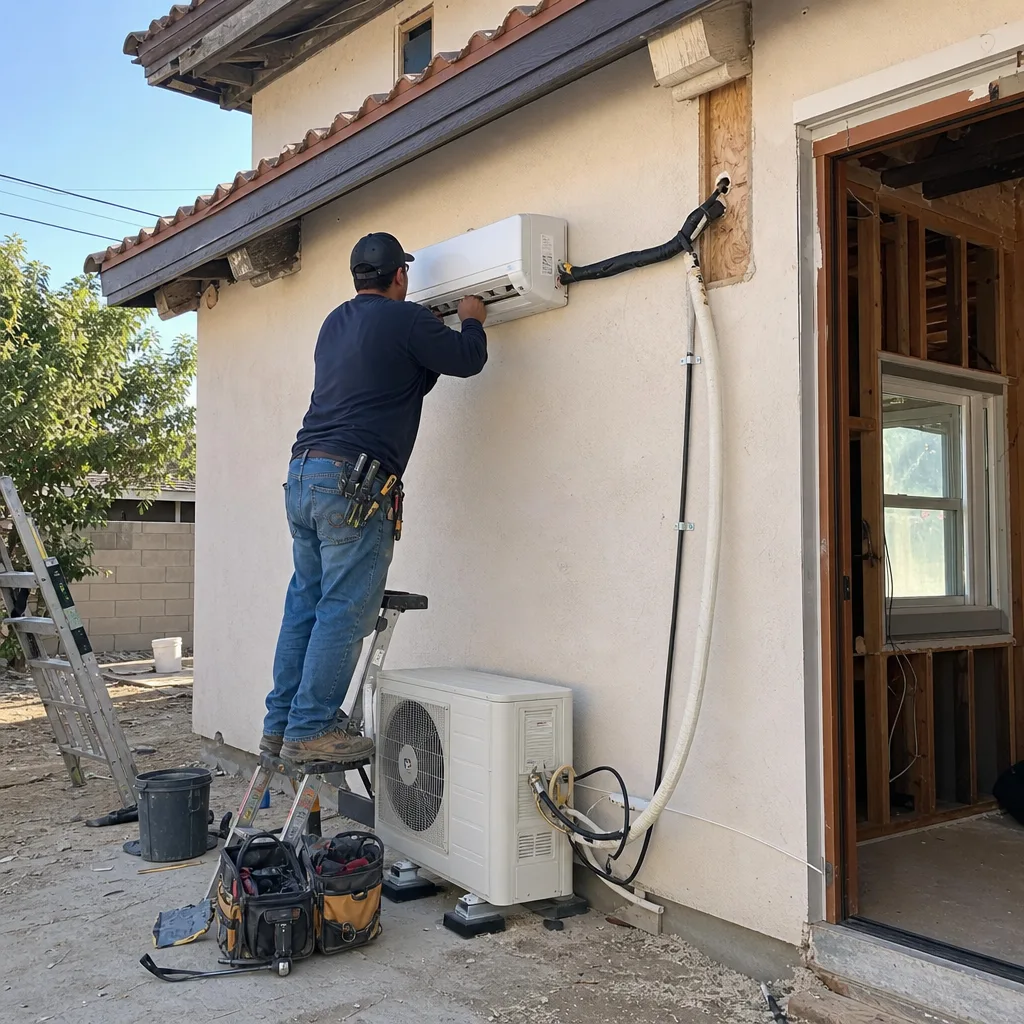
Call a design-build studio when you have confirmed your property qualifies for ADU construction under San Bernardino’s zoning but need clarity on actual project cost, timeline, and permit feasibility. Call when you hold competing bids that do not align. Call when a contractor has told you “the designer will handle permits” or “we’ll figure out utilities in the field” - both statements transfer risk to you without pricing it.
Specific scenarios that warrant professional review: properties in the foothill zones with grading concerns; garage conversions in pre-1970 homes with unknown foundation conditions; any project where the primary residence has a septic system rather than sewer connection; and homeowners who have received a bid with more than 20 percent of the total in allowances rather than fixed prices.
Ellery ADU Studio San Bernardino offers free estimates in San Bernardino. A live person answers calls 24/7 at (909) 359-6463. Every estimate includes a written price before any work starts, per Haven Standard Clause 1.
Frequently Asked Questions
Garage conversion ADUs in San Bernardino typically run $95,000-$155,000 all-in, drawings through final inspection. New detached ADUs range $180,000-$320,000 depending on size, site conditions, and utility complexity. These ranges include design, permitting, construction, and standard finishes. Call (909) 359-6463 for an exact quote - estimates are free, and every project is quoted with a written price before any work begins.
A B-General contractor cannot legally produce stamped architectural drawings. You need either a licensed architect, a design-build studio with architectural staff under the same contract, or a contractor who subcontracts design (which creates two-party liability). In San Bernardino, the permit set must include Title 24 energy calculations and structural details that a B-General license does not cover. Our ADU Design & Permitting Maintenance Checklist for San Bernardino Homeowners covers the full requirements.
San Bernardino’s Planning Division and Building & Safety Division typically complete ADU plan review in 8-14 weeks for standard projects, assuming no corrections. Complex sites, historic overlays, or septic system properties may extend this. Construction adds 4-8 months depending on scope and weather, with summer heat in San Bernardino sometimes limiting concrete pours and exterior work scheduling.
Under a properly structured contract with fixed line items, the price should not change unless you request scope modifications. The Haven Standard, Clause 5 (No Surprises), locks the scope at signing with no door-side upsells. Be wary of contracts with undefined allowances or “exhibit” exclusions that convert to change orders. Call (909) 359-6463 for a written fixed price - estimates are free.
Ellery ADU Studio pulls all permits as part of the single-contract design-build process. The permit application lists our license number, and we coordinate all inspections. If a contractor asks you to pull permits “to save money,” they are likely avoiding liability for code compliance or lacking the license classification required for the work described.
Prefab and modular systems from brands including Mighty Buildings, Boxabl, and Plant Prefab can work in San Bernardino if the specific model has structural engineering approved for California’s seismic and wind requirements. Ellery ADU Studio specifies and coordinates these systems within the same single contract, handling site prep, utility integration, and final inspection as fixed-price line items - not as open-ended coordination. Call (909) 359-6463 to discuss whether prefab fits your property and budget.
The Bottom Line
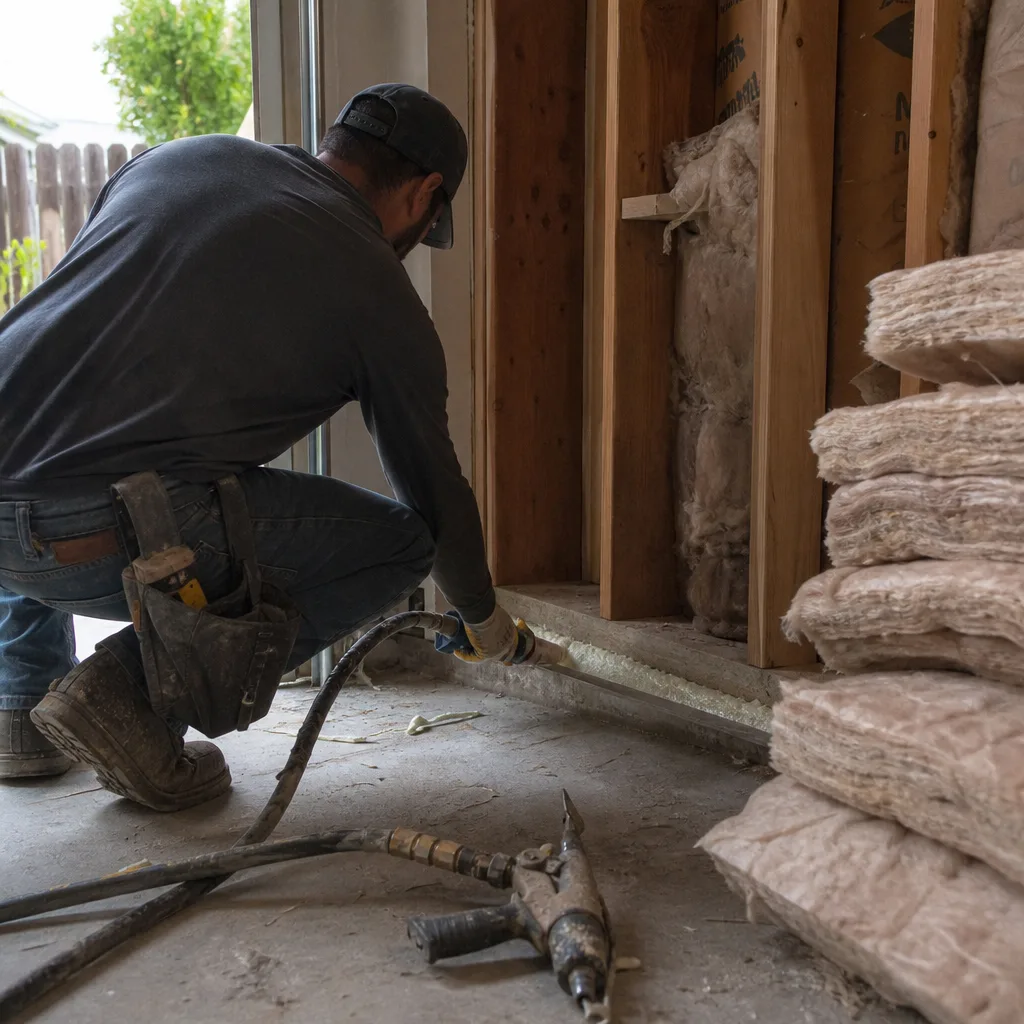
Hiring an ADU contractor in San Bernardino is not primarily about finding the lowest bid or the friendliest salesperson. It is about structuring a contract that eliminates the designer-builder blame gap, verifies real insurance coverage, and fixes the price before work starts. Verify licenses against the actual work required. Read insurance certificates for named-insured protection. Compare bids only after adding missing line items at market rate. And insist on permit-set ownership in writing, because the drawings are the asset that outlasts any single contractor relationship. The 900-plus ADUs Ellery ADU Studio has designed, permitted, and built since 2015 share one common feature: every one started with a written price, a documented plan, and a single party responsible for both.
Written by Nadia Ellery, Owner at Ellery ADU Studio San Bernardino, serving San Bernardino since 2015.